
A wall-hung toilet is attached to a mounting frame, with the cistern usually concealed behind a stud wall. A floor-mounted toilet rests on the floor and typically features a visible cistern, although models with a concealed reservoir do exist. Both designs have their advantages: a wall-hung toilet makes the floor easier to clean, while a floor-mounted toilet is generally cheaper and simpler to replace.
The best choice depends primarily on the existing drainage, available space, and your renovation budget. During a complete remodel, you can adjust the connections and install a concealed cistern. If you only want to replace an outdated toilet bowl, a floor-mounted model is often more practical.
In this guide, we compare the pros and cons of wall-hung versus floor-mounted toilets, discuss the technical requirements, and look at the costs of installing or replacing both models in the Netherlands in 2026.
Wall-hung vs. floor-mounted toilet: what is the difference?
When choosing a new toilet it is not just about the look. The construction, the type of cistern, and the connection to the sewer determine how much space and installation work are required.
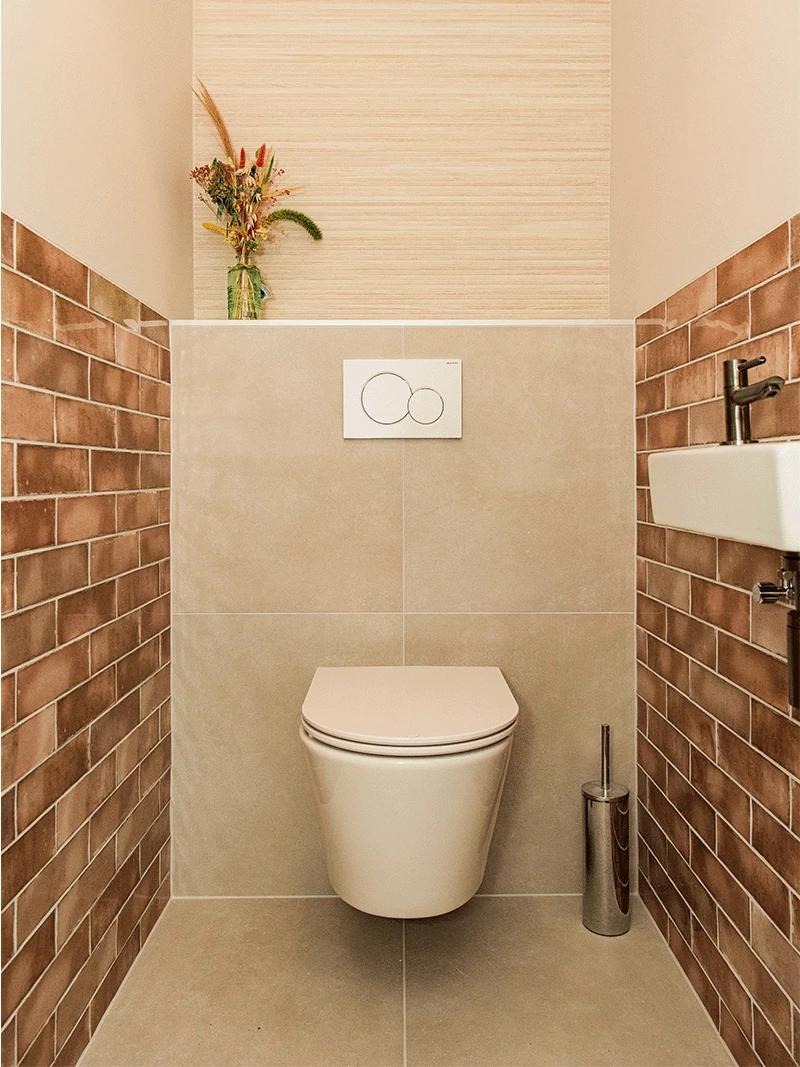
Wall-hung toilet with concealed cistern
A wall-hung toilet, also known as a wall-mounted toilet, is attached to a specially designed mounting frame. The toilet bowl does not touch the floor, leaving the space underneath clear.
The concealed cistern is usually located behind a finished stud wall. Only the toilet bowl and the flush plate are visible.
This provides a sleek look and makes cleaning the floor easier. However, the installation requires sufficient space for the frame, the cistern, and the wall finish.
Floor-mounted toilet with exposed or concealed cistern
A floor-mounted toilet is placed directly on the floor. With traditional models, the cistern is visible behind or above the toilet bowl.
There are also floor-mounted models where the cistern is concealed within the wall. Therefore, a floor-mounted toilet does not always have to have a classic look.
The main practical advantage is that a suitable model can often be placed on existing connections without major changes to the walls.
Comparing wall-hung and floor-mounted toilets
The table below shows the main differences.

A wall-hung toilet is therefore not automatically more compact. Nor is a floor-mounted toilet inherently sturdier or more reliable. The quality of the components and the installation is the deciding factor for both types.
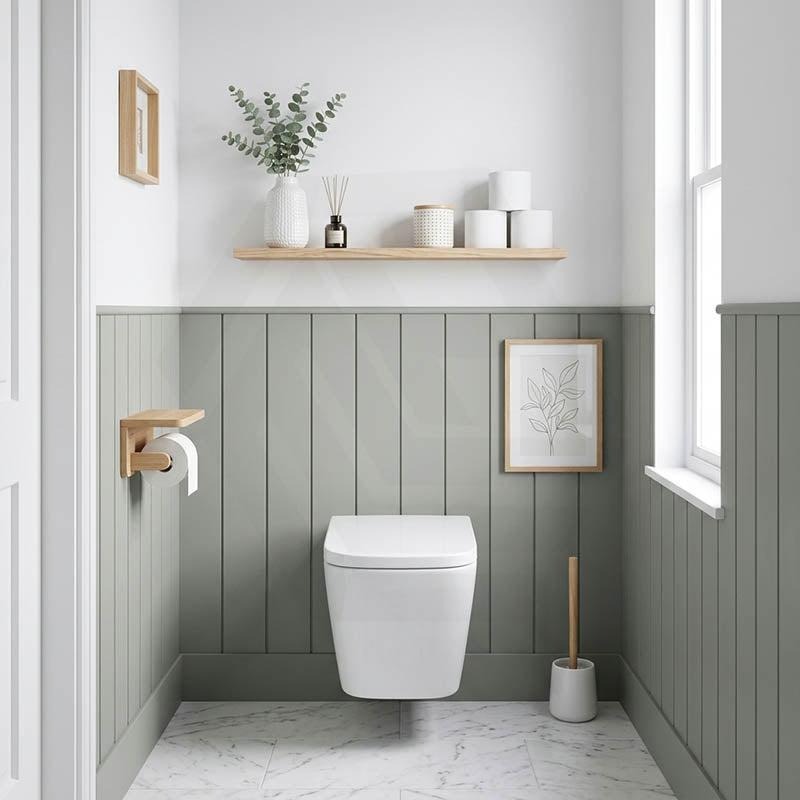
Wall-hung toilet: pros and cons
A wall-hung toilet with a concealed cistern is a popular choice for modern bathroom and restroom renovations. It offers particular advantages for daily cleaning and for creating a calm, uniform space.
On the other hand, installation generally requires more work than replacing a floor-mounted model.
Advantages of a wall-hung toilet
The main advantage is ease of cleaning. Because the toilet bowl hangs above the floor, you can easily mop the area underneath. There is no toilet base where dirt can accumulate.
In addition, a wall-hung toilet has a sleek appearance because the cistern and the main connections are concealed behind the wall.
Another advantage is that many mounting systems allow the seat height of the wall-hung toilet to be adjusted during installation to suit the users. This can be convenient for taller individuals or people who have difficulty standing up.
Modern concealed cisterns are also often equipped with a dual-flush button, allowing you to choose between a small and a large flush. The actual water consumption depends on the settings and the flushing system used.
Disadvantages of a wall-hung toilet
The main disadvantages are the higher installation costs and the space required for the mounting frame.
In addition to the toilet bowl, you need a concealed cistern, a flush plate, and a suitable wall structure. During a renovation, this may also involve adjustments to the water supply and sewage pipes.
Furthermore, the stud wall can reduce the depth of the toilet area. Especially in a small restroom, the total dimensions of the installation must be calculated, including the cistern, wall finish, and toilet bowl.
The mounting frame must also be installed correctly. Improper installation can lead to the toilet bowl moving, leaks, or damage to the wall finish.
How sturdy is a wall-hung toilet?
A common question is whether a wall-hung toilet has sufficient load-bearing capacity.
Modern installation systems are designed to support significant loads. Geberit, for example, states that certain correctly installed systems have been tested to support loads of up to 400 kg.
That value applies to the entire installation under the manufacturer's mounting conditions. It does not mean that every toilet bowl or randomly secured structure can automatically handle the same load.
The support frame is attached to suitable structural elements according to the chosen system. This requires taking into account the construction of the floor, the wall behind it, and the specified mounting points.
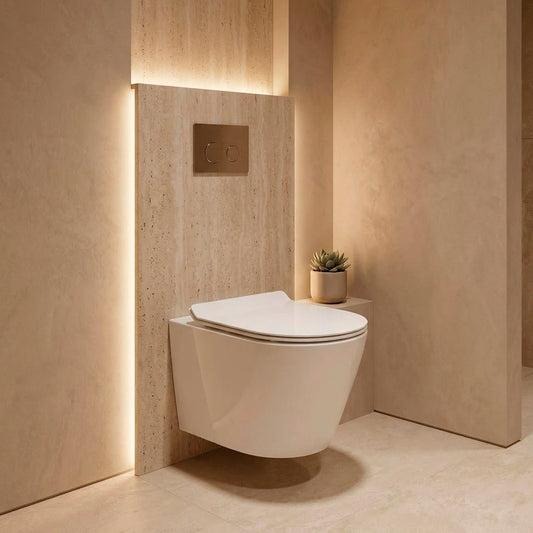
Floor-mounted toilet: pros and cons
A floor-mounted toilet remains a practical choice, especially if you do not want to completely renovate your existing restroom.
Installation is generally simpler if the new toilet bowl matches the existing drain and water connection. Modern floor-mounted models are also available in various compact and sleek designs.
Advantages of a floor-mounted toilet
Replacing a floor-mounted toilet is often cheaper than switching to a wall-hung model.
If the existing connection is suitable, there is usually no need to build a new stud wall. Additionally, an exposed cistern can be easily accessed for maintenance of the fill or flush mechanism.
Furthermore, floor-mounted toilets are available in various heights, sizes, and designs. This allows you to choose a model that fits the available space and your specific needs.
Disadvantages of a floor-mounted toilet
The main disadvantage is the connection between the base of the toilet and the floor. This can make cleaning more difficult, especially with models that have hard-to-reach edges.
An exposed cistern also takes up space and can make the restroom look more cluttered.
That does not apply to every floor-mounted toilet. Compact models and designs with a closed back offer a different look and can be easier to clean.
Close-coupled, back-to-wall, and compact toilets
There are several different designs within the category of floor-mounted toilets.
A close-coupled toilet consists of a floor-mounted bowl with a cistern attached directly to it. This is a commonly used solution for a simple replacement.
A back-to-wall toilet also sits on the floor, but its back fits flush against the wall. Depending on the model, the cistern is either hidden or integrated into the installation.
For small restrooms, there are also compact and shortened toilet bowls. These have a smaller projection depth, which can leave more legroom.
Do pay attention to the existing drain. Not every compact or back-to-wall model will fit a floor or wall connection without modifications.
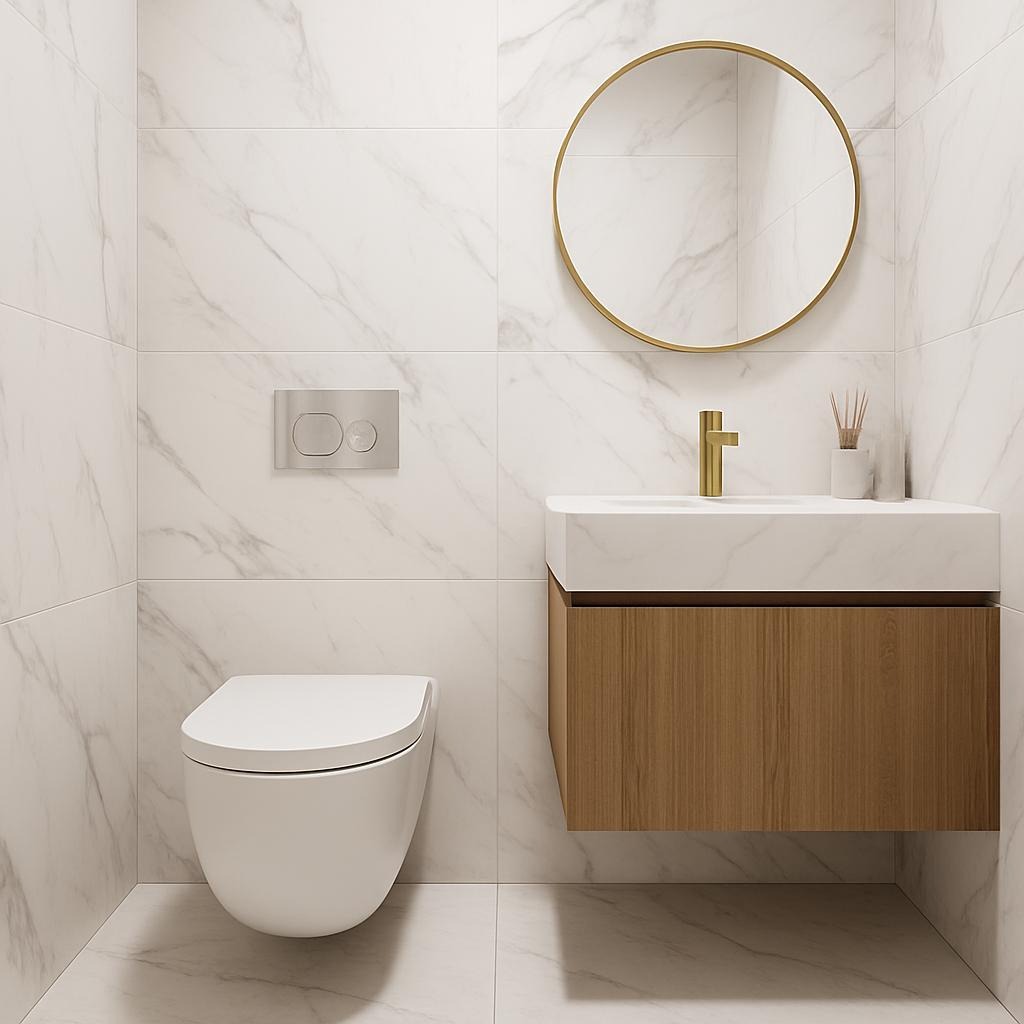
From floor-mounted to wall-hung toilet: what does it involve?
Anyone looking to replace a floor-mounted toilet with a wall-hung one must first check whether the existing connections are suitable.
The switch generally requires more work than just removing the old toilet bowl. The position of the sewer drain and the available space behind the toilet are the deciding factors.
Floor or wall drain
A floor-mounted toilet can be connected to either a floor drain or a wall drain. With a wall-hung toilet, the drain is connected to the sewage system via a horizontal connection.
If the existing drain is in the floor, you must determine whether a suitable connection bend can be used or if the plumbing needs to be adjusted.
Special transition pieces are available for certain situations. As a result, it is not always necessary to relocate the entire drain.
The possibilities depend on the position of the drain, the available space, and the requirements of the installation system.
Have this assessed in advance. Incorrect connections can cause leaks, blockages, and problems that are difficult to access.
Installing a wall-hung toilet: installation sequence
When installing a wall-hung toilet, the structure, drain, and wall finish are built as a single system.
A standard sequence is:
- Remove the existing toilet and check the drain and water connection.
- Position the installation frame, align it, and secure it according to the instructions.
- Connect the drain and water supply and check for leaks.
- Build and finish the stud wall, ensuring the service opening remains accessible.
- Mount the toilet bowl and flush plate, then test the flush.
During a full renovation, these tasks are coordinated with the tiling, floor finishing, and any hand basin installation.
In our toilet renovation step-by-step guide you can read how these tasks fit into the overall renovation schedule.
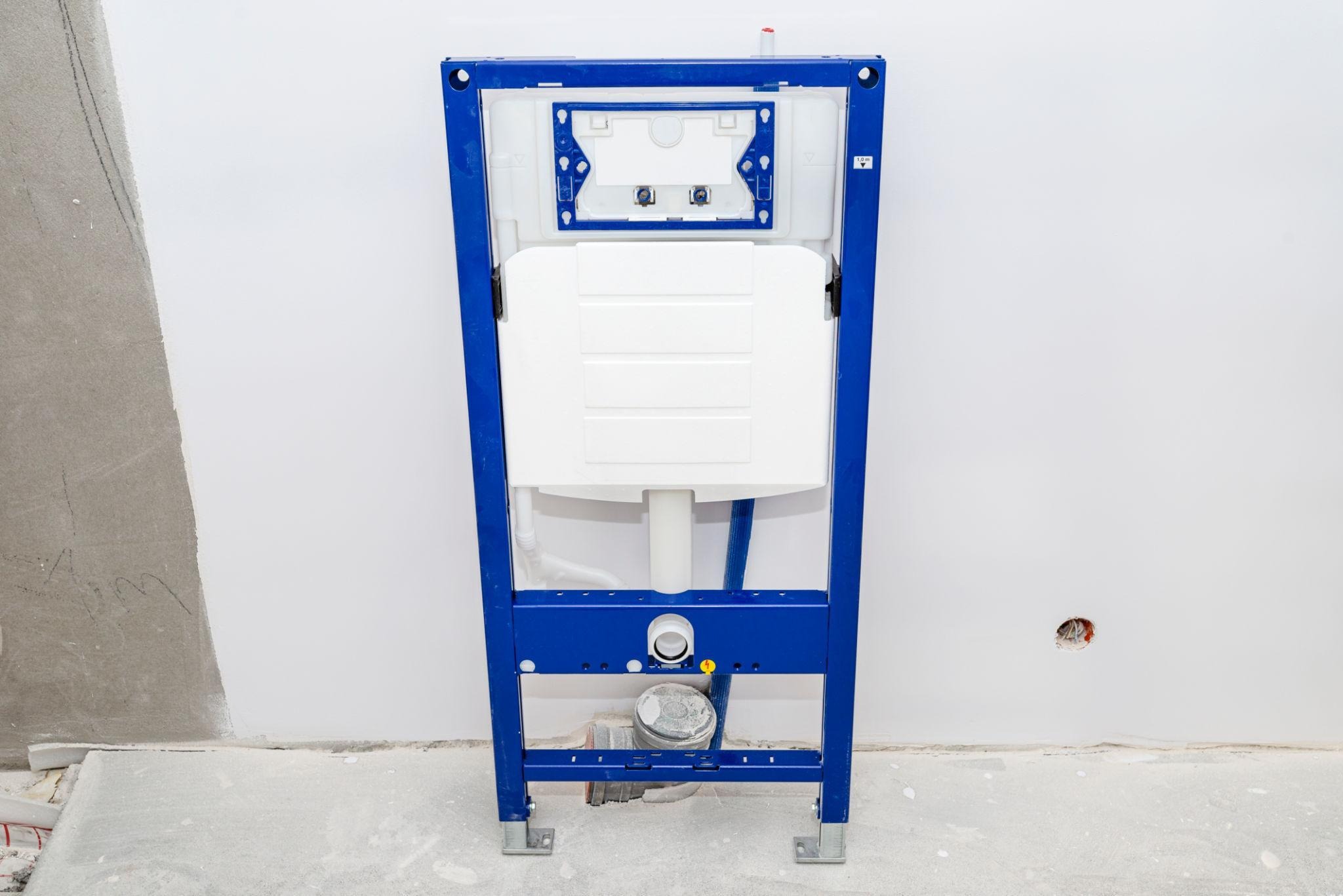
Maintenance of a concealed cistern
Repairing a concealed cistern does not automatically mean the tiled wall has to be broken open.
In modern systems, the most important maintenance components are usually accessible via the service opening behind the flush plate.
After removing the plate, a plumber can check and, depending on the system, replace the fill valve or flush valve.
The flush plate must therefore be compatible with the cistern being used. The service opening must also remain accessible after the wall has been finished.
Only in the case of certain hidden leaks or damaged connections outside that opening might it be necessary to partially open the wall.
Dimensions: seat height, mounting, and legroom
When choosing between a wall-hung or floor-mounted toilet, the overall dimensions are often more important than the dimensions of the visible toilet bowl.
Especially in a small restroom, you must take into account the stud wall, the door opening, and the available legroom.
Center-to-center distance and compatibility
If you only want to replace the bowl of a wall-hung toilet, the new bowl must fit the existing mounting points and connections.
Many wall-hung toilets use a center-to-center distance of 180 or 230 mm between the mounting points. Always check which distance corresponds to your existing frame.
The connections for flush water and drainage must also match the new toilet bowl. The same center-to-center distance does not automatically mean that every bowl will fit without further verification.
Seat height and available space
With a wall-hung toilet, the installation height can be chosen within the limits of the system. This height must be determined before the wall is finished.
With a floor-mounted toilet, the seat height is primarily determined by the model.
Also, measure the distance from the finished wall to the front of the toilet bowl. For a wall-hung toilet, be sure to include the thickness of the stud wall.
A shortened wall-hung toilet can be an attractive option when space is limited, but a compact floor-mounted toilet may require less total depth in some situations.
If you want to install a shower toilet later, discuss whether a suitable electrical connection and any additional water supply are needed during the renovation.
How much does a wall-hung or floor-mounted toilet cost in 2026?
The cost of a wall-hung or floor-mounted toilet consists of the price of the sanitary ware, the installation, and any necessary adjustments to the room.
A simple replacement usually keeps costs limited. When you convert a floor-mounted toilet to a wall-hung model and need to adjust pipes or wall finishes, the total can increase significantly.
Costs for replacing a floor-mounted toilet
For replacing a floor-mounted toilet, Dutch price estimates for 2026 mention amounts of approximately €300 to €700, including standard materials and installation.
This applies primarily when the existing drain and water connection can be retained.
If you choose a more expensive model or if the floor needs to be repaired, the total price may be higher.
Costs for installing a wall-hung toilet
For a wall-hung toilet with a concealed cistern, indicative amounts of approximately €600 to €1,400 are mentioned for a standard installation, depending on the chosen system and the work included.
With a complete conversion, additional costs may arise for adjusting the drain, the stud wall, and the tiling.
A quote should therefore clearly indicate whether the amount refers only to the toilet and its installation or also includes all structural work.
Costs of a complete toilet renovation
When the entire toilet room is being renovated, demolition, tiling, plumbing, a potential washbasin, and finishing work also come into play.
At Bricknest, a complete toilet renovation starts from €3,500 according to published pricing information. This is a base price for a compact room with a standard layout; the final costs depend on the technical condition and choice of materials.
More information about the individual cost items can be found in our guide onthe costs of a full toilet renovation.
Which toilet best suits your situation?
The choice between a wall-hung or floor-mounted toilet depends on how much you want to renovate and what you value in daily use.
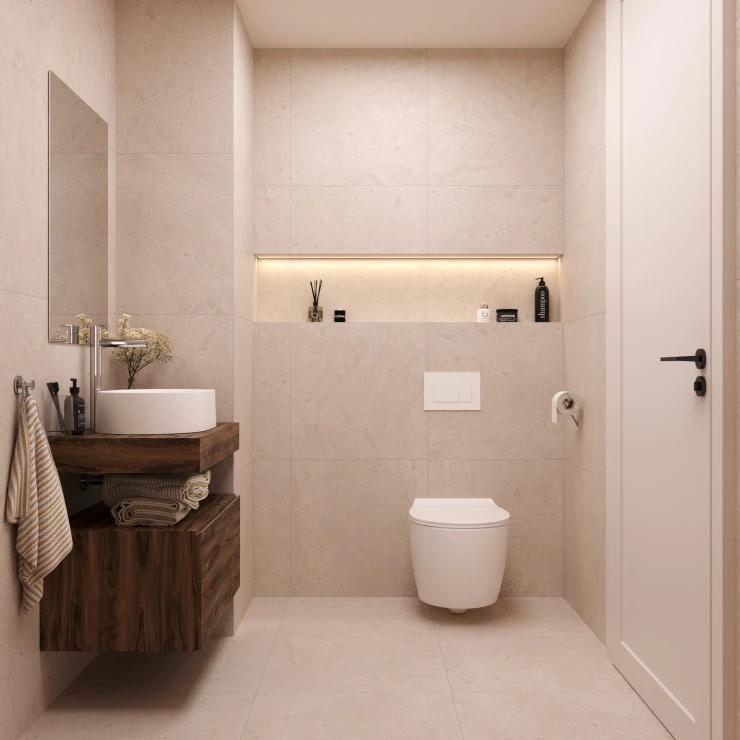
A wall-hung toilet is particularly attractive when you are completely renovating the toilet room, want a clear floor, and the available space is suitable for a concealed cistern.
A floor-mounted toilet is often more sensible when you want to replace an existing installation quickly and the drain can remain in the same location.
In a small restroom, a compact model—whether wall-hung or floor-mounted—can be the best solution. Therefore, always compare the total installation depth and not just the visible dimensions of the toilet bowl.
Is the toilet in the bathroom and are the shower, sink, or wall finishes also being renewed? Then it is wise to look at the sanitary layout as a whole. The bathroom renovation step-by-step plan helps to coordinate the technical work.
Frequently asked questions about wall-hung and floor-mounted toilets
When choosing between the two models, questions often arise regarding load-bearing capacity, maintenance, dimensions, and the possibility of retaining existing components.
Is a wall-hung toilet suitable for heavier individuals?
Yes, provided a suitable mounting system is installed correctly. Some systems, including certain Geberit models, are tested to support up to 400 kg. The specified load-bearing capacity applies to the entire assembly when installed according to the manufacturer's instructions.
Can you replace just the bowl of a wall-hung toilet?
Often, yes. The new bowl must fit the existing mounting points and connections. Check the bolt spacing, the position of the drain, and compatibility with the mounting system.
Do you have to remove tiles to repair a concealed cistern?
Usually not for routine maintenance of the fill or flush valve. Modern cisterns typically have a service opening behind the flush plate. If there is hidden damage outside of this opening, some demolition work may be required.
Can a wall-hung toilet be connected to an existing floor drain?
In certain situations, this is possible using a suitable connection bend. Sometimes the drain needs to be modified. The right solution depends on the available space and the position of the sewer connection.
Which toilet is best for a small space?
A compact floor-mounted toilet or a shortened wall-hung toilet may be suitable. A wall-hung model leaves the floor clear, but the stud wall takes up space. Therefore, compare the total dimensions, including the cistern and wall finish.
Is a floor-mounted toilet more reliable than a wall-hung toilet?
Not necessarily. Reliability is primarily determined by the quality of the toilet bowl, the cistern, the connections, and the installation. Both systems can function trouble-free for years if installed correctly.
Conclusion: choosing between a wall-hung or floor-mounted toilet?
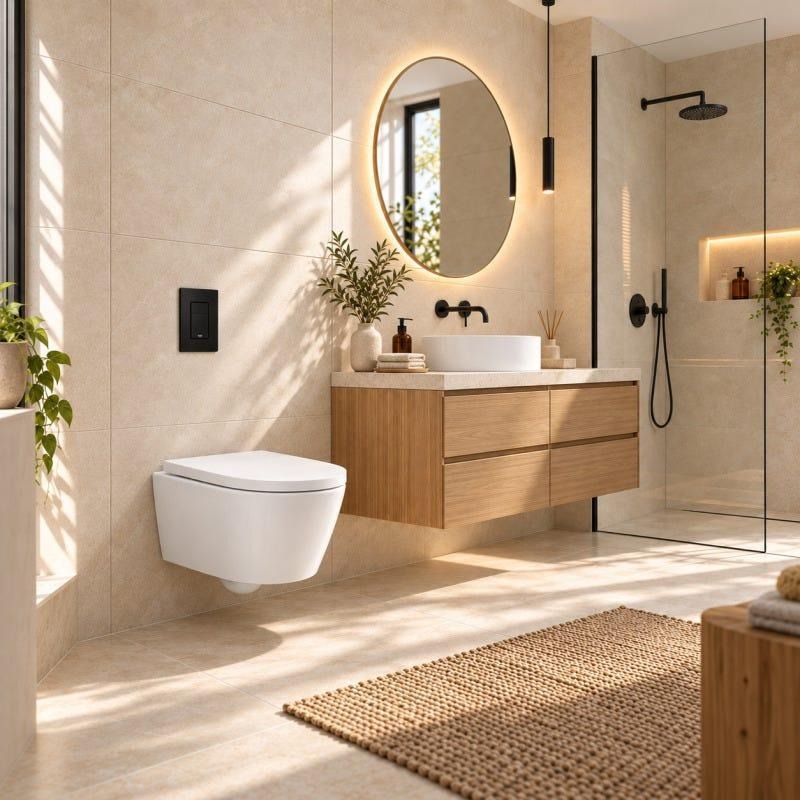
A wall-hung toilet offers particular advantages for cleaning and provides a sleek look. This requires a suitable mounting frame, a concealed cistern, and sufficient space behind the toilet bowl.
A floor-mounted toilet is generally cheaper and easier to replace if the existing connections are retained. Modern compact and back-to-wall models also offer more design choices than traditional versions.
Before purchasing, check the position of the toilet drain, the total installation depth, the mounting dimensions, and the installation costs. This will help you avoid unnecessary adjustments during renovation and ensure you choose a toilet that fits your space, budget, and daily use.

