
Good stucco not only determines how sleek a home looks, but also how sustainable the further finish remains. A wall that is not flat enough can cause problems with painting, wallpaper, tiles or custom furniture. If you are considering having stucco done, you should not only look at the appearance, but also at the surface, adhesion, drying time and final finish.
In the Netherlands, costs and implementation methods vary considerably. A smooth wall in a new-build home requires a different approach than a damp bathroom wall or a damaged wall in an older building. Knowing in advance what types of stucco exist, how the price is built up and what a good professional pays attention to will prevent wrong choices and unexpected additional costs.
Types of stucco
Stucco is chosen based on the space, the condition of the surface and the desired final finish. Not every layer of plaster has the same function. Some types are intended to level walls before painting, others are used, on the contrary, as a visible decorative finish.
The technical conditions also play a role. Think of moisture load, cracking, suction of the surface and the thickness of the layer. During renovations, Bricknest therefore first assesses the existing walls before determining the type of finish.
Interior stucco
Interior stucco is used to level walls and ceilings. It forms the basis for paint, wallpaper or other finishes. Depending on the desired end result, the wall can be delivered wallpaper-ready or ready for sauce. Wallpaper-ready means that the wall is flat enough for wallpaper, but not always tight enough for immediate painting. Sausklaar requires a finer finish, because paint makes any imperfections visible.
The surface must be stable, clean and resilient. Loose old layers, dust, grease and moisture reduce adhesion. A primer is required for highly absorbent walls so that the plaster dries evenly and does not lose moisture too quickly. In case of major damage or crooked walls, scraping may be necessary first: a thicker layer that corrects larger deviations.
In older homes, attention should also be paid to old layers of paint, layers of lime, salt outflow, cracks and residual moisture in the wall. If these problems are not treated first, new plaster may peel off, discolor, or crack later.
Decorative stucco
Decorative stucco is intended as a visible final finish. Examples include spachtelputz, concrete look, clay plaster, tadelakt or microcement-like systems. This is not only about flatness, but also about texture, color, gloss and pattern. The implementation requires more control, because recovery points often remain visible later.
When it comes to decorative finishes, preparation is extra important. The surface must be smooth, as the finish coat is usually applied thinly. The connection to corners, frames and skirting boards must also be done tightly. In living rooms, entrances and kitchens, decorative stucco is often chosen to create a calm, seamless look.
Moisture-resistant stucco for the bathroom
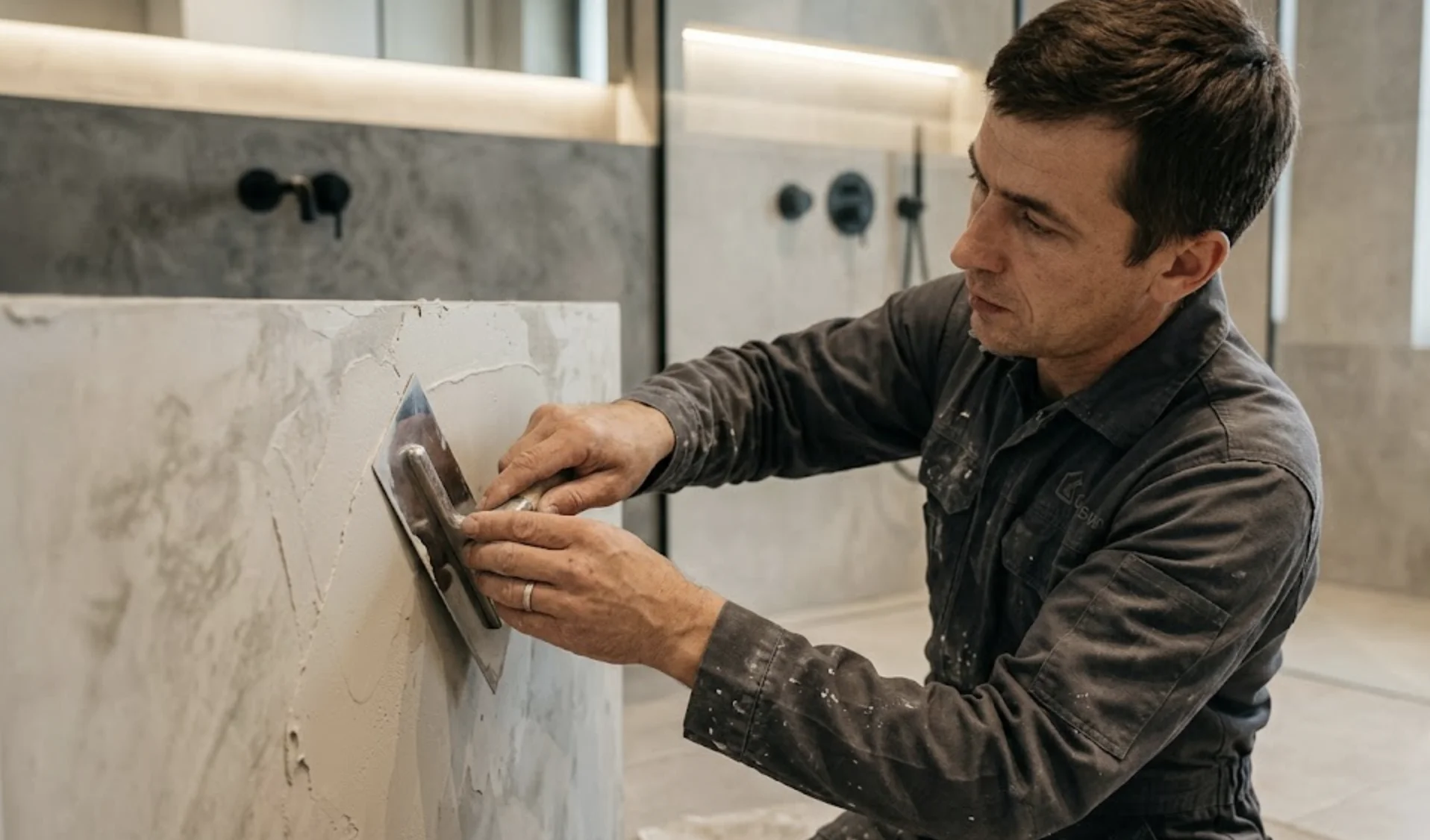
Bathrooms require a different system than dry living areas. Ordinary gypsum stucco is not suitable for zones with direct moisture load. In practice, the search query for bathroom stucco waterproof is not about ordinary gypsum plaster, but about a complete moisture-resistant system with a suitable surface, seal and finish.
In addition, the structure is more important than just the visibility layer. The wall must be prepared correctly, seams and corners must be sealed and wet areas require additional protection. Especially around shower walls, bath edges and washbasins, the finish should not have any weak spots. A nice surface is only reliable if the entire system is moisture-proof.
Please note that “waterproof” is not only determined by the visibility layer. In wet areas, primer, belt, corner seal, suitable surface, correct layer structure and maintenance of sealant seams are also decisive. Therefore, always ask whether the chosen system is suitable for direct water loading in shower or bath areas.
Cost of stucco
The price of stucco depends on more factors than just the number of square footage. A large, flat new building wall can be finished relatively efficiently. An old home with damaged walls, small spaces and many corners requires more preparation and labour.
For a realistic budget, therefore, not only the lowest m² price should be considered. The condition of the surface, accessibility, drying time, choice of materials and desired finish quality together determine the final price.
Price per m²
The stucco price per m²2 In the Netherlands, it is usually lower for standard smooth interior stucco and higher for ceilings, renovation work or specialist finishes. As an indicative market bandwidth, standard wall stucco often mentions around €10 to €35 per m², depending on the surface, finish, region and project scope. Always check that the price includes VAT, materials, primer, masking, preparation, call-out costs and waste disposal. The prices are clearly higher for bathrooms and watertight systems; concrete, ciré, tadelakt and microcement can range from €90 to €160 per m² or more.
These amounts are indicative. An exact price can only be determined after inspection of the space. Especially for renovation projects, preparatory work, such as removing old layers, repairing cracks or applying primer, can increase overall costs.
For homes older than two years, the reduced VAT rate of 9% may apply to labor costs for plastering work on the home. This does not automatically apply to all materials or additional activities. Therefore, let the quote clearly break down which part is labour and which part is material or extra costs.
What influences the price
The final offer consists of labor, material, preparation and finishing. In doing so, a plasterer looks at technical and practical circumstances. Not every wall requires the same layer thickness, drying time or material structure.
Key pricing factors include:
- the condition and flatness of the existing walls;
- the type of stucco: wallpaper-ready, ready-to-use, decorative or moisture resistant;
- the number of square meters and the layout of the space;
- the number of corners, frames, pipes and connection details;
- the accessibility of the home or floor;
- the desired planning and drying time.
A low m² price is therefore not automatically advantageous. If preparatory work is missing from the offer, additional costs may arise later. A good quote therefore describes not only the end result, but also the technical preparation.

Choosing a plasterer
The quality of stucco depends very much on experience, choice of materials and method. Minor errors in the preparation may later become visible as cracks, stains, peeling layers or wavy walls. That is why it is wise not to select by price alone.
A good professional asks questions about the surface, the space and the desired finish. He also indicates when a particular solution is technically unwise. This is particularly important for damp rooms, old walls or projects where multiple finishes connect.
Professional plasterer
Hiring a professional plasterer means looking at more than smoothing a wall. A professional assesses the suction of the substrate, chooses the right primer, checks the layer thickness and finishes corners and connections neatly. Planning is also important, because stucco must dry sufficiently before painting, tiling or assembly.
When choosing, pay attention to proven experience and clear communication. Ask about previous projects, photos of similar work, and an explanation of the materials used. A reliable plasterer can explain why a particular technique is suitable for the space.
Pre-checking prevents many problems. Pay particular attention to these points:
- experience with the desired type of stucco;
- clear description of preparation and finishing;
- realistic planning including drying time;
- transparent price structure per m² or per project;
- warranty or repair agreements in case of defects.
If you discuss these points in advance, you reduce the risk of misunderstandings during implementation. This is certainly important for larger renovations, where stucco often coincides with painting, floors, electricity and customization.
When is a specialist needed
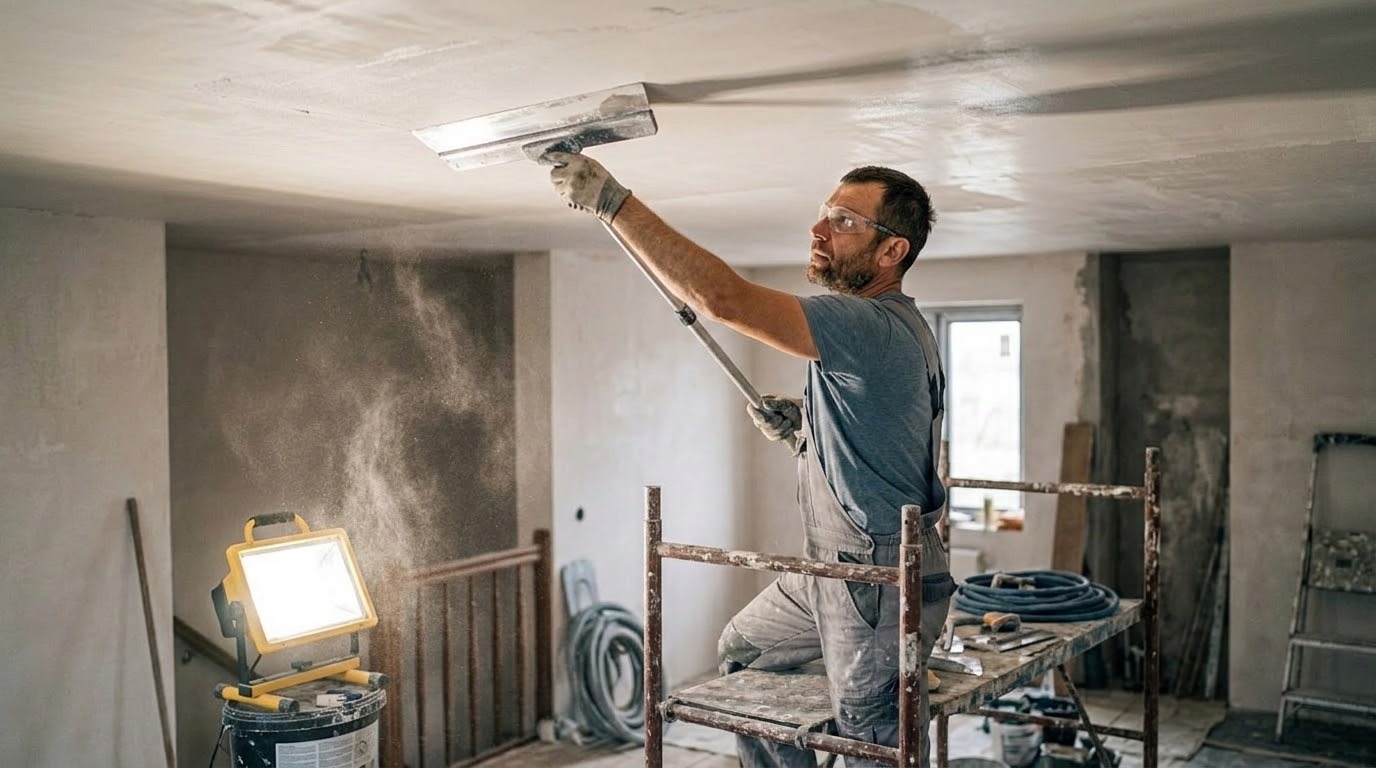
A specialist is particularly needed for large surfaces, ceilings, severely damaged walls, damp areas and decorative finishes. Expertise is also important for older homes, because surfaces there are often uneven, brittle or contaminated. A standard layer of plaster is then not always sufficient.
Specialized knowledge is required for bathrooms, concrete-look finishes or crack-sensitive surfaces. This involves system construction, adhesion, moisture protection and detailing. In such cases, Bricknest works with controlled implementation steps, so that the finish matches the technical condition of the room.
Order and quote
A good quote prevents discussion during implementation. Stucco seems easy to compare based on a m² price, but in practice, quotes can vary greatly. One price includes only labor and basic plaster, while the other also includes primer, corner profiles, repairs, and finishes.
That is why an application must be as concrete as possible. Indicate which areas need to be plastered, what the condition of the walls is and what final finish is desired. Photos, dimensions and information about the surface help to get a better initial assessment.
Request a quote
If you are looking for a stucco quote, you should not only look at the total amount, but especially at the activities included in the price. The quote must clarify which activities are included and which are not. Also ask if the price includes material, VAT, waste preparation and disposal.
For larger projects, an on-site recording is recommended. A plasterer can then see whether walls are straight enough, whether there are cracks and whether extra preparation is needed. Without inspection, a price often remains provisional.

What does the quote include
A complete quote describes the work technically and financially. As a result, the client knows what is being delivered and the schedule can be better tailored to other activities in the home.
A good quote usually includes:
- the number of m² per space;
- the type of stucco and the desired finish;
- the required materials, primer and profiles;
- preparing the surface;
- the price per m² and any fixed costs;
- the start date, run time and drying time;
- agreements about warranty and repair points.
Also record how defects are reported after delivery and within what reasonable period of time repair will take place. When discussing adhesion, cracks or moisture spots, it is important that the cause and repair method are recorded in writing.
After receiving the quote, it is wise to discuss unclear items immediately. Especially for bathrooms, decorative finishes and renovation walls, it must be clear which system is used and how the surface is being prepared. Only then can stucco be technically done properly and the result will remain tight and reliable even after years.

